The Four Ways We Pay Attention: Why Nideffer’s Model Matters in a World of Overwhelm
At Pod Health, we spend a lot of time helping people understand how their minds work—not to control every thought or feeling, but to build flexibility, compassion, and choice. One of the most powerful tools for doing that is understanding attention.
--
By Pod Health LLC
Attention is the gateway to experience.
It shapes what we notice, what we miss, how we feel, and how we act.
And in a world overflowing with pressure, stimulation, and constant demands, attention has become one of our most precious psychological resources.
One of the clearest frameworks for understanding attention comes from sport psychologist Dr. Robert Nideffer, who mapped attention across two simple dimensions. But when we look at his model through the lens of Relational Frame Theory (RFT) and Contextual Behavioral Science (CBS), something deeper emerges:
Attention isn’t just a skill. It’s a relational process that shapes meaning, emotion, and behavior.
Let’s explore how.
---
🔹 The Two Dimensions of Attention
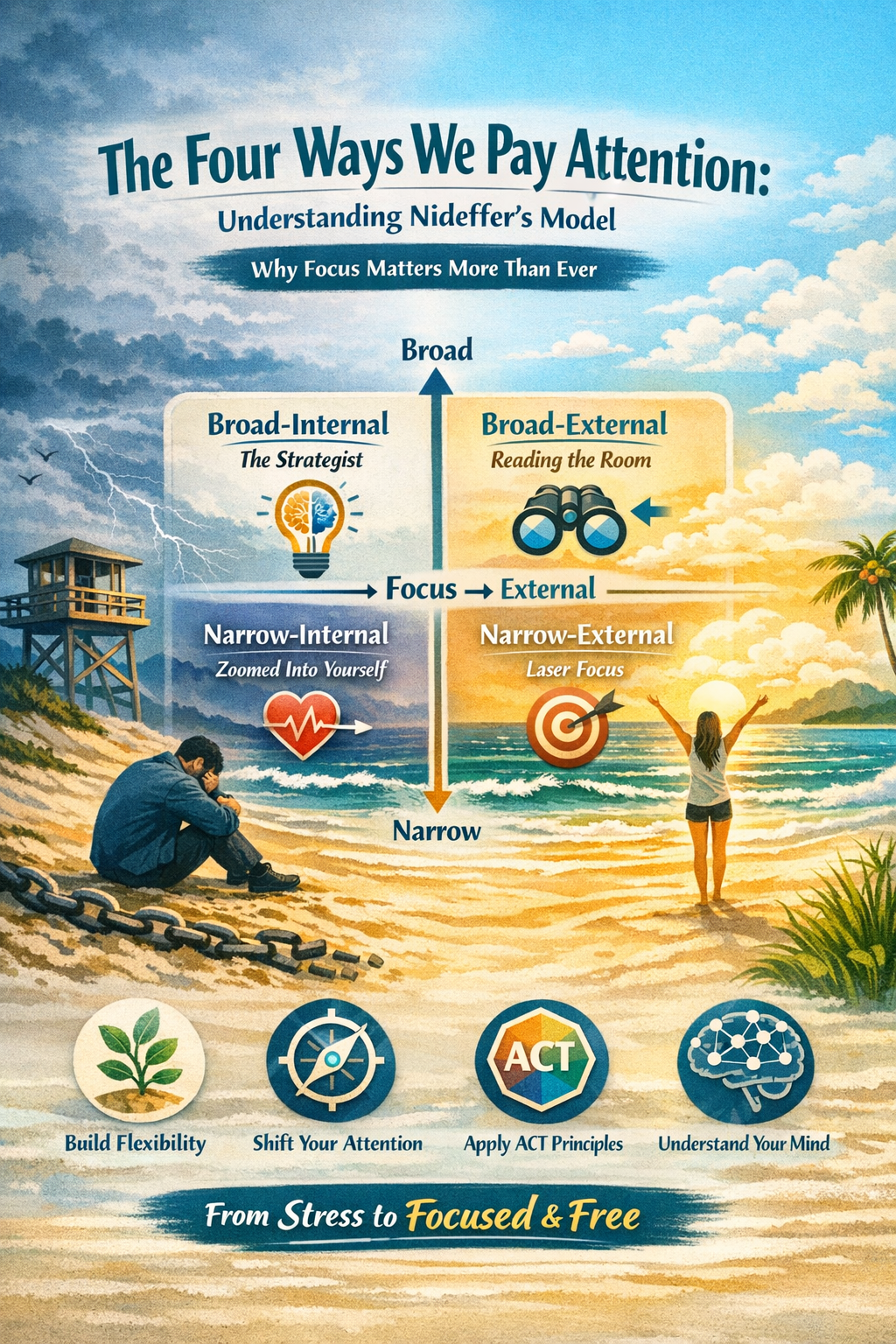
Nideffer proposed that attention varies along two axes:
1. Width
• Broad — taking in many cues
• Narrow — focusing on one or very few cues
2. Direction
• Internal — thoughts, sensations, memories
• External — environment, tasks, surroundings
Combine them, and you get four attentional styles we all move between.
---
🔷 The Four Attentional Styles
Broad–Internal Broad–External
Narrow–Internal Narrow–External
Each mode has strengths.
Each mode has vulnerabilities.
And the real magic is in flexibility.
---
🟣 1. Broad–External: “Reading the Room”
This is your scanning attention—taking in many cues at once.
Examples:
• A quarterback reading a defense
• A clinician tracking a client’s body language
• A parent monitoring a busy room
• A teacher sensing the emotional tone of a class
Strength: Big-picture awareness.
Risk: Overwhelm.
RFT Connection:
Broad–external attention expands the relational network.
You’re noticing multiple cues and linking them:
“this is like that,” “this predicts that,” “this contradicts that.”
It’s powerful—but cognitively expensive.
---
🟢 2. Broad–Internal: “The Strategist”
This is reflective, analytical, meaning-making attention.
Examples:
• Planning your week
• Exploring values
• Integrating insights in therapy
• Understanding patterns in your life
Strength: Insight, creativity, perspective-taking.
Risk: Overthinking.
RFT Connection:
This is where humans build complex relational frames:
• identity frames (“Who am I?”)
• temporal frames (“Where am I headed?”)
• hierarchical frames (“What matters most?”)
It’s essential for growth—but can become rumination when fused with fear.
---
🔴 3. Narrow–External: “Laser Focus”
This is precision attention—locking onto one external target.
Examples:
• A surgeon during a delicate procedure
• A musician hitting a specific note
• A runner pacing their stride
• A student focusing on one problem
Strength: Accuracy and performance.
Risk: Missing context.
RFT Connection:
Narrow–external attention reduces relational complexity.
It’s “this one thing, right now.”
This is the attentional mode of committed action in ACT.
---
🟡 4. Narrow–Internal: “Zoomed Into Yourself”
This is intense inward focus.
Examples:
• Mindfulness of breath
• Noticing one sensation
• Anxiety loops
• Rumination
Strength: Grounding, self-awareness.
Risk: Panic, fusion, self-monitoring spirals.
RFT Connection:
This is where relational frames can become rigid:
“I feel this → something is wrong.”
“This sensation → danger.”
“This thought → truth.”
Narrow–internal attention is powerful when intentional—and painful when automatic.
---
🌪️ Stress Shrinks Attention
One of Nideffer’s most important insights is also one of the most human:
Under stress, attention collapses.
We tend to fall into:
• Narrow–Internal (panic, rumination, self-criticism)
• Narrow–External (hyperfixation on threat)
From an RFT perspective, this makes perfect sense.
Stress tightens relational frames.
Meaning becomes rigid.
The mind defaults to survival mode.
This is why athletes “choke,” clients shut down, and parents lose perspective in hard moments.
---
🌱 Why This Model Matters in Therapy & Human Development
Nideffer’s model becomes even more powerful when integrated with ACT, RFT, and Contextual Behavioral Science.
1. It helps people understand their stress patterns
Naming your attentional mode creates distance:
“I’m stuck in narrow–internal right now.”
That’s defusion.
2. It gives a map for shifting attention
A simple sequence can restore flexibility:
1. Notice you’re in narrow–internal
2. Expand to broad–external (5 things you see)
3. Reflect in broad–internal (values, big picture)
4. Act in narrow–external (one small step)
This is attentional agility—the foundation of resilience.
3. It aligns perfectly with ACT processes
• Narrow–Internal → Fusion
• Broad–Internal → Values, perspective-taking
• Broad–External → Present-moment awareness
• Narrow–External → Committed action
Attention becomes the bridge between experience and behavior.
---
🧠 How to Train Attentional Flexibility
Here are Pod‑Health‑style micro‑practices:
1. Orientation (Broad–External)
Name 5 things you see, 3 you hear, 1 you feel.
2. Values Journaling (Broad–Internal)
“What matters to me today?”
3. Box Breathing (Narrow–Internal)
A steady internal anchor.
4. One-Step Action (Narrow–External)
Pick one task. Do it for two minutes.
The goal isn’t to live in one mode.
It’s to move intentionally between them.
---
⭐ Final Thoughts: Attention Shapes Reality
Nideffer’s model gives us a language for something we all feel intuitively:
Where attention goes, experience follows.
Your attention can:
• steady you
• overwhelm you
• empower you
• shrink you
• or expand you
But once you understand the four attentional styles—and learn to shift between them—they become tools rather than defaults.
Attention becomes choice.
And with choice comes freedom.
---
At Pod Health LLC, we believe that when people understand the processes behind their thoughts, emotions, and behaviors, they gain the power to change their lives in profound ways.
If you’d like to explore these ideas further—or learn how to apply them with families, children, or clinicians—visit us at:
🔗 https://podhealthllc.com